
This post contains affiliate links.
You can keep a cat out of the Christmas tree by making the tree steadier, the base less inviting and the rest of the room more interesting. No single trick works for every cat, so the nine steps below are meant to be combined.
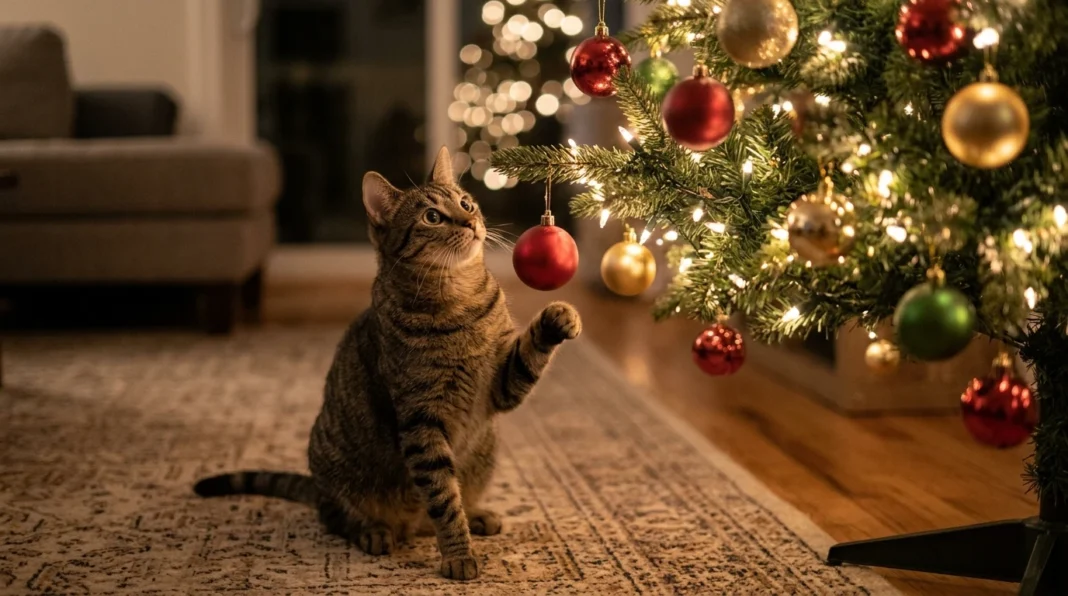
If you have ever woken at 3 a.m. to the sound of ornaments hitting the floor, you already know the problem. A tree is the best toy your cat has seen all year: it is tall, it smells of outdoors, and it is covered in things that dangle.
Why cats go for the tree
Cats are not being naughty. The tree triggers several instincts at once.
- Climbing: cats feel safer up high, and a tree is a ready-made ladder with a view.
- Hunting: swinging ornaments and twinkling lights move like prey.
- Novelty: a large new object in their territory has to be sniffed, rubbed and tested.
- Chewing: needles, ribbon and cords have textures many cats like to bite.
Knowing which of these drives your cat tells you where to start. A climber needs a stable tree and a blocked base. A chewer needs the tempting parts out of reach. If your cat tears around the room at night, our article on why cats get the zoomies explains what is going on.
9 ways to keep your cat out of the Christmas tree
1. Pick the spot before you pick the tree
Stand the tree away from sofas, shelves and windowsills, which cats use as launch pads. A corner gives you two walls to anchor to.
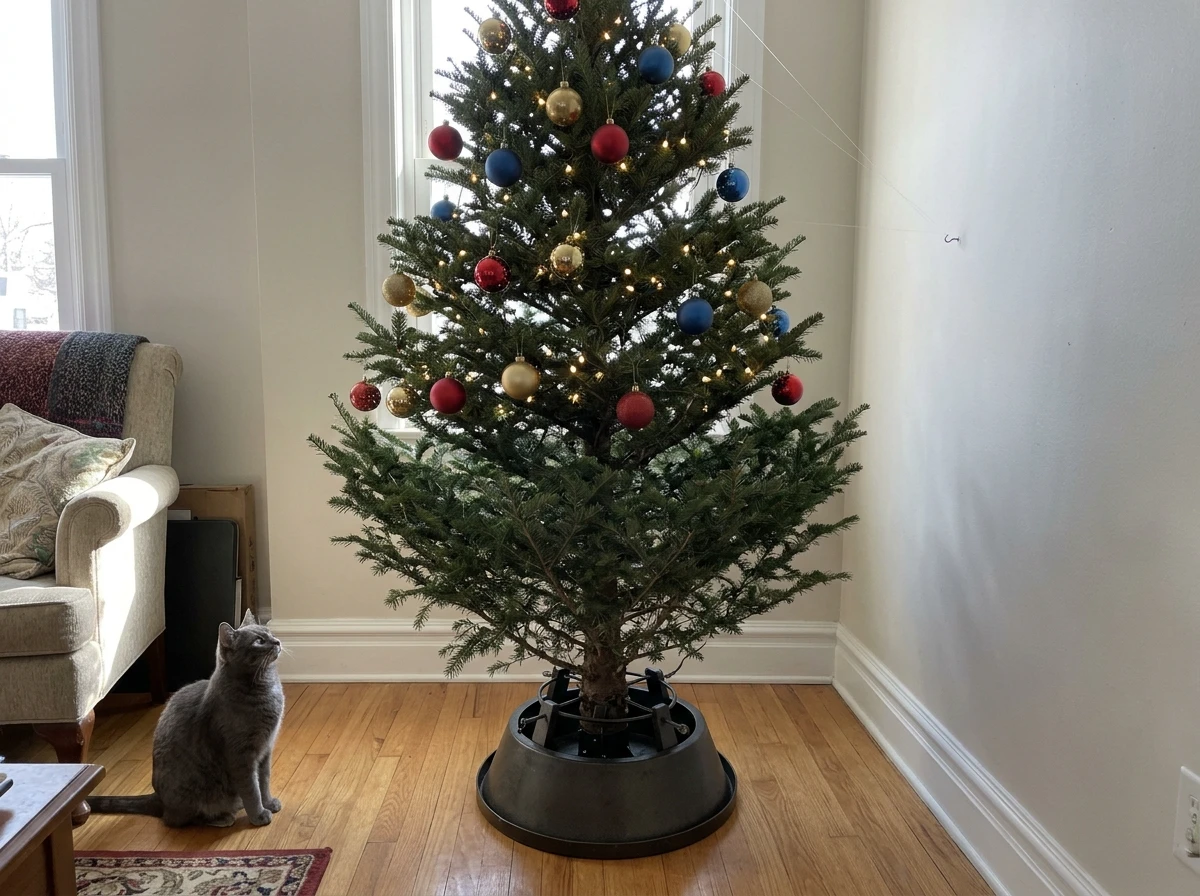
2. Anchor it
Use a heavy, wide stand and tie the upper trunk to a wall hook or the ceiling with fishing line. A tree that does not sway is less fun to climb and far less likely to fall.
3. Leave it bare for a few days
Put the tree up undecorated first. Many cats lose interest once the newness wears off, and nothing breaks while they investigate.
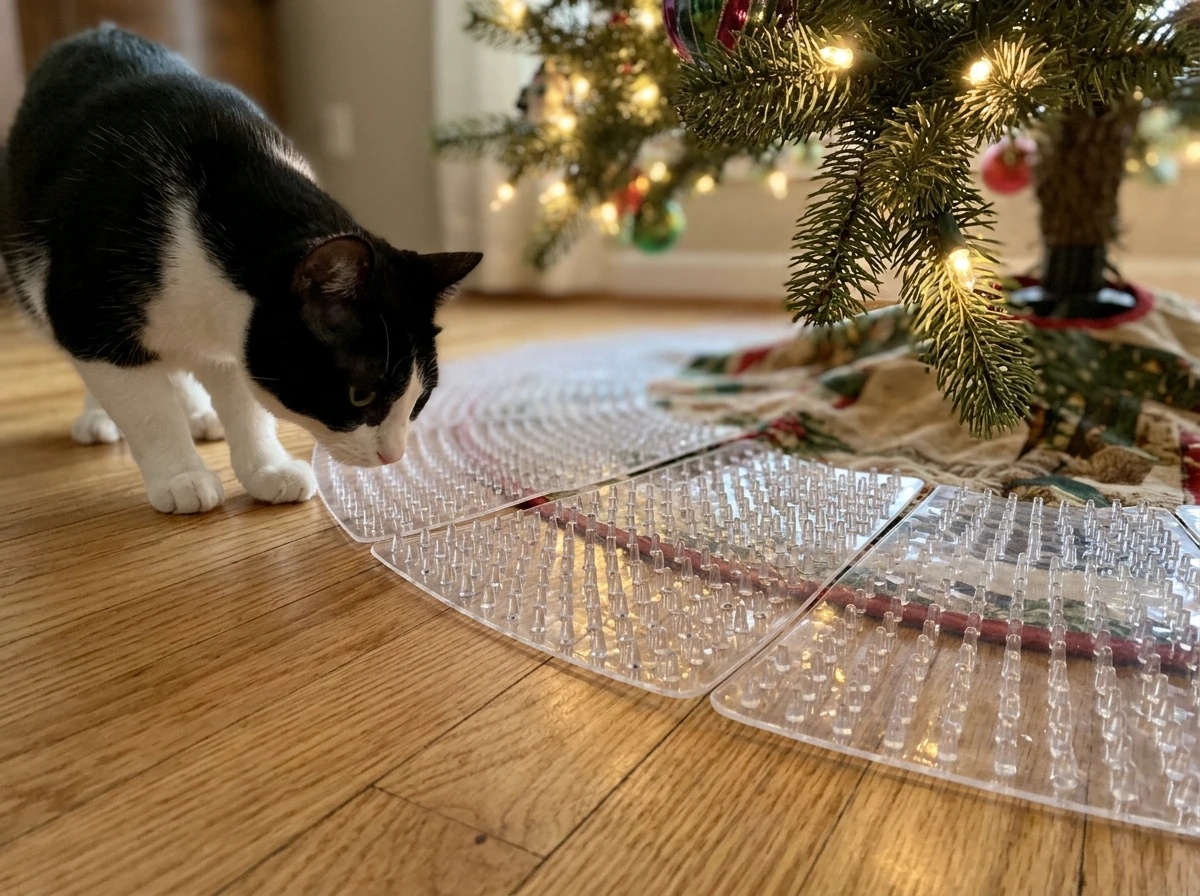
4. Block the base with a deterrent mat
Cats reach the trunk by walking across the floor under the tree. A plastic spike mat, often sold as a scat mat, has blunt flexible prongs that feel unpleasant under paws without causing injury. Lay the pieces in a ring around the stand or under the tree skirt. After the holidays the same mats work on counters, sofas and plant pots. Two options on Amazon: the Petfolio 12-pack of 16 x 13 inch spike mats, which you can arrange in a ring around the stand, or a 6.5 ft spike mat roll that you cut to fit.
5. Decorate from the middle up
Keep the bottom third of the tree plain, or use only soft, unbreakable ornaments there. Hang fragile and sentimental pieces high and close to the trunk.
6. Fasten ornaments properly
Swap wire hooks for twist ties or ribbon knotted tightly to the branch, so a swat does not send anything flying.
7. Skip tinsel and hide the cords
Tinsel and long ribbon are easy to swallow. Run light cords through a cord cover and unplug them when you are out.
8. Cover the water
If you have a real tree, wrap the stand so your cat cannot drink from it.
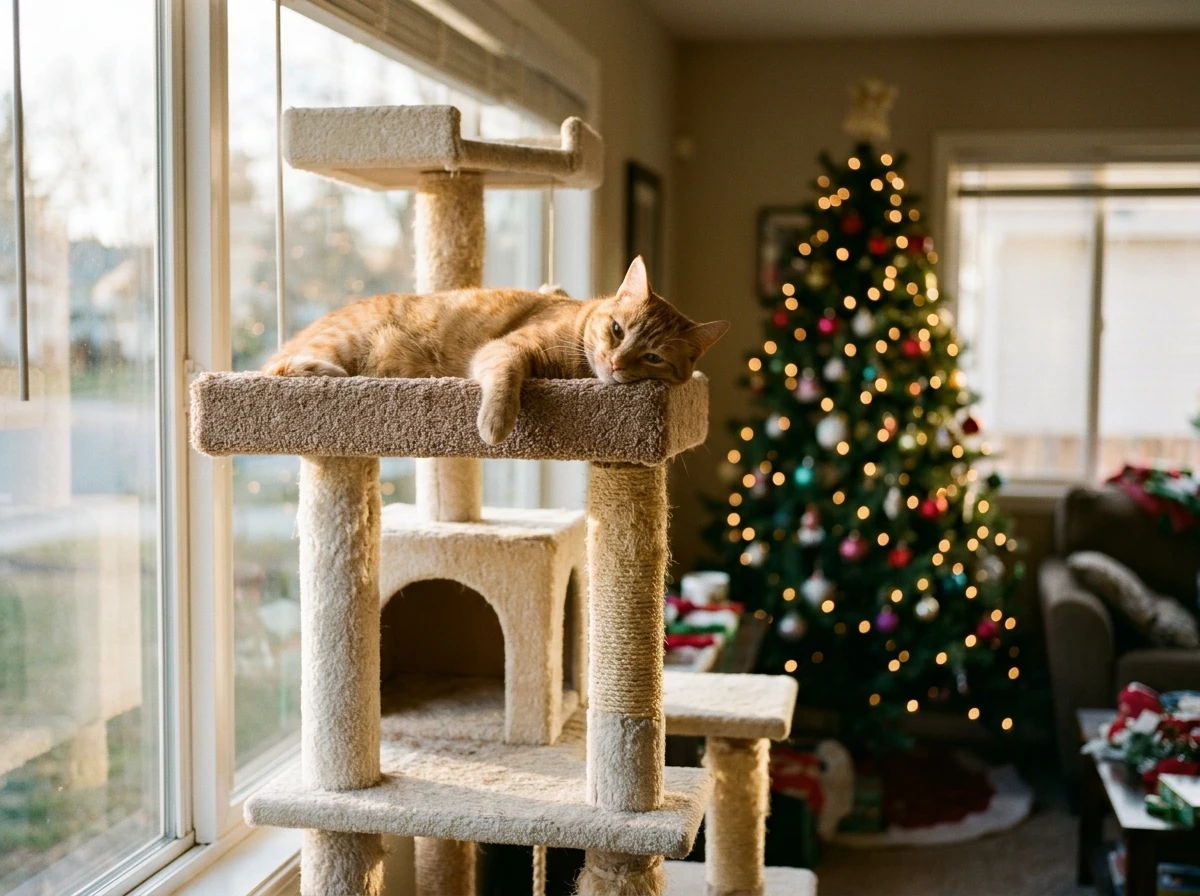
9. Give them something better
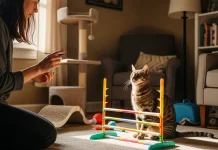
Put a cat tree or window perch in the same room and play with a wand toy for ten minutes before the evening, when most cats are at their most active. A tired cat with its own climbing spot has less reason to choose yours. Our guide to training your cat has more on redirecting behavior.
Steps 2 and 4 do the most work for determined climbers. Steps 5 to 7 matter most for cats that bat and chew.
Tree hazards to remove first
A toppled tree is a nuisance, but a few decorations are a real danger to cats.
| Hazard | Why it matters | What to do |
|---|---|---|
| Tinsel, ribbon, string | Can be swallowed and cause an intestinal blockage | Leave them off the tree entirely |
| Light cords | Chewing can cause burns or electric shock | Use cord covers and unplug when unsupervised |
| Glass ornaments | Shatter into sharp pieces on the floor | Use shatterproof ones on lower branches |
| Tree water | May contain preservatives, sap or bacteria | Cover the stand |
| Seasonal plants | Lilies are highly toxic to cats; mistletoe and holly can also make them ill | Keep them out of the house or well out of reach |
| Edible decorations | Chocolate is toxic to cats, and strings of food invite chewing | Do not hang food on the tree |
If your cat swallows tinsel or string, chews a live cord, or eats part of a lily, call your veterinarian straight away. Do not pull on string hanging from your cat’s mouth.
What not to do
- Do not punish or shout. It teaches your cat to fear you, not the tree, and they will simply wait until you leave.
- Do not use essential oils as a repellent. Many, including citrus and pine oils, can harm cats.
- Do not rely on a spray bottle. It only works while you are in the room.
- Do not use sticky traps or anything that could hurt paws. A deterrent should be unpleasant, never painful.
Frequently asked questions
Will my cat grow out of it?
Many adult cats calm down after the first few days. Kittens and young cats usually need the full set of precautions for the whole season.
Do deterrent mats hurt cats?
Mats made for pets have blunt, flexible plastic prongs. They feel odd underfoot, so cats choose to walk elsewhere. Check that the mat you buy is sold for pet use and that the prongs bend under your hand.
Is a real or an artificial tree safer?
Both can be made safe. Real trees shed needles that can irritate the mouth and stomach if eaten, and they need water. Artificial trees avoid both but can still be chewed, so watch for missing pieces.
What if nothing works?
Put the tree in a room with a door you can close, or use a smaller tabletop tree on a surface your cat cannot reach.
The short version
Anchor the tree, block the base, keep the bottom branches boring and give your cat its own place to climb. Most households need two or three of these steps together, and the first week is the hardest.
As an Amazon Associate, Meow Mommies earns from qualifying purchases.